S. Waman
Serious MenS. Waman is a minister whose life and public presence join two forms of power: the authority of a political office and the ability to mobilize Dalit anger. He presents himself as a man who escaped caste oppression through struggle, but his own account of that struggle includes both childhood humiliation and a later career built around violent street mobilization. When he visits the BDD Chawl, Ayyan Mani seeks to turn Waman’s attention into leverage for redevelopment; Waman, in turn, uses the gathering to celebrate Adi Mani as a figure of collective Dalit possibility.
Public Image and Political Authority
Waman arrives at the BDD Chawl amid elaborate public staging. A two-storey banner presents him as a dynamic personality, while its enlarged portrait makes him appear stunted: he wears a safari suit, joins his palms in greeting, and has a thick, sharply edged moustache. The poster artist has rendered his face light pink, since the artist was not free to paint it black. At the banner’s base, its small-print credit names P. Bikaji, who waits nearby in a sweat-soaked white kurta, trembling under a massive rose garland. The disparity between the minister’s monumental image and the crowded, improvised ceremony gives the visit a distinctly political theatre.
When someone announces Waman’s arrival, the crowd surges into the road. A pilot jeep stops, followed by a light-blue Mercedes; four armed bodyguards hurry from the jeep and push through the people to open the minister’s door. Waman emerges in a starched white kurta with his palms joined. Bikaji hails him as the leader of the masses, and the crowd repeats the acclaim. The conspicuous security surrounding a politician who presents himself as a representative of the poor makes the distance between popular identification and official power visible without dissolving either one.
Origins and the Making of a Political Career
Speaking to the residents, Waman recounts that when he was Adi’s age, Brahmin priests tied him to a tree for entering a temple. They left him there through the night. The next morning he fled his village for Bombay, with no money and, as he tells it, not even a pocket. His story gives his later public authority a personal origin in the humiliations imposed by caste: the minister’s claim to speak for Dalits is grounded in an experience of exclusion, not merely in political rhetoric.
Ayyan knows a longer, less polished account of Waman’s ascent. Waman once sold vegetables from a wooden cart near Crawford Market, then became a thug. He threw stones and broke shop windows in protests against causes he did not understand, and in grief for leaders he had never known. From there he became a coordinator of freelance goons and eventually entered politics. His particular political skill, as Ayyan understands it, is the ability to assemble angry Dalit youths at short notice and turn their anger into violent action.
That history is set against the continuing poverty of the people whose cause Waman claims. In modern times, Ayyan observes, the Untouchables have gained the nominal right to be touched by upper-caste people but remain the city’s poorest. When Dalits feel insulted—for example, when someone garlands Ambedkar’s statue with slippers—Waman can lead a battalion of furious youths into the streets, where whole lanes may be looted. Ayyan has also watched looters return carrying large cartons of Adidas goods. The episode captures the uneasy mixture of protest, humiliation, material deprivation, and opportunistic violence surrounding Waman’s form of mass politics.
The Visit to the BDD Chawl
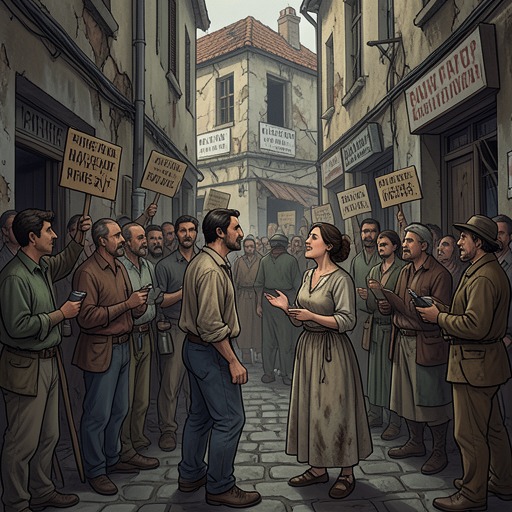
Ayyan greets Waman with both hands around the minister’s hand before touching his own chest. The two walk along the chawl’s broken, cobbled ways while at least three hundred people follow and photographers jog backwards ahead of them. Waman looks across the rows of identical grey buildings. Ayyan reminds him that he, too, once lived in a chawl; Waman answers with pride in the old hardship of his years in Grant Road. Their exchange establishes a point of recognition, but it also turns quickly toward the residents’ present material need.
Ayyan explains that the residents want to keep their neighbours and their lives together, even as builders offer to buy them out. The current offer is twelve lakhs for a 150-square-foot flat. Waman advises Ayyan to push the price to fifteen lakhs, looking over the real estate as if calculating its value. The advice is concrete, but it is not a completed settlement: before leaving, Waman invites Ayyan to meet him at his office so that they can work out a way to sell the place. For Ayyan, whose own stated hope is to leave the chawl for proper flats and give his children a better life, the minister’s access may be useful, but the promise remains an opening for negotiation rather than a secured outcome.
The encounter is built around personal access as much as public policy. Ayyan is identified to the minister by the crowd, walks beside him through the neighbourhood, and receives an invitation to continue the discussion privately at the office. Waman’s authority here operates through direct attention, public presence, and the possibility of intervening in a redevelopment bargain. The residents’ needs, however, exceed the exchange: as Waman leaves, people call out for jobs, money, and welfare. He nods without meeting anyone’s eyes and tells them to go home and have faith in the government.
Adi as Public Symbol
On the terrace of Block Number Forty-One, Waman addresses a crowd assembled around a table draped in white. He recounts his childhood temple-entry punishment before turning to Adi, whom he calls a rare boy and presents as the future liberator of the Dalits. He emphasizes that Adi is only eleven and has been permitted to take one of the world’s toughest examinations, then urges the audience to show the world the power held within them. The applause makes the boy’s reported ability into a shared public emblem: Adi is presented not only as an exceptional child but as proof of possibility for a marginalized community.
Waman gives Adi a large cardboard box, with the boy standing between the minister and Ayyan as its nominal recipient. The gift is a computer: back home, Adi tries to pull the monitor from its carton and tells his father that he now has one. The scene connects political spectacle to a tangible object, while preserving the difference between the public meaning assigned to Adi and the child’s immediate delight in the new machine. Ayyan, meanwhile, is unsettled by Waman’s knowledge of his son’s name and by the power behind the minister’s attention, even as other stories about Waman make him seem more endearing to Ayyan.
Public Platform and Significance
Waman’s public persona includes an ability to make old hardship serve as both testimony and political credential. He has told the press about meeting Michael Jackson and describing him as polite and unarrogant, a small episode that sits beside his harsher history of caste humiliation and street politics. The contrast resists a simple portrait of him as either a heroic representative or merely a violent operator: his authority draws on personal suffering, media performance, political office, and the capacity to summon a crowd.
Later, at a packed press conference in the minister’s office, Waman sits beside Ayyan behind a table crowded with microphones. Photographers kneel in front while cameramen and reporters struggle for room. The country’s attention has turned toward Adi and the story of the Dalit genius, and Waman claps for silence before handing Ayyan a microphone. He does not supply the substance of Ayyan’s address in this scene; instead, his presence and the platform of his office place the father before the assembled press. Across the chawl visit and the press conference, Waman’s role is to convert access to political power into a public stage—one on which housing claims, community pride, and the manufactured image of a prodigy can all be made visible.